Category
Product Design · Design Systems · AI-Assisted Workflow
Year
2026
PontePay — Earn Global, Spend Local
Send dollars, receive pesos, the contract holds the money until both sides confirm. No middleman, no custody, no frozen funds.
The Problem
Argentina runs on two currencies. People earn and save in dollars, but spend in pesos, every day. Converting between them today means a KYC-heavy centralized exchange, a custodial wallet controlled by a company, or an informal P2P trade with a stranger and no guarantees. Stablecoins already make up over 50% of all ARS exchange purchases (Chainalysis, 2025), and Argentina is #2 in Latin America by crypto volume. The demand was there. A transparent, non-custodial way to do it wasn't.
What We Heard from Real Users
We talked with three people who move USDC to pesos regularly: Vivi, Tomás, and Sofia [one line each on who they are, e.g. "a freelance developer billing clients abroad"]. [1-2 sentences on what actually came up in those conversations, the real pain points]. That shaped two of the clearest product decisions: showing the live market rate next to the official BCRA rate instead of a black-box number, and using an on-chain escrow so no single party, including us, ever holds the funds mid-trade.

Working with AI
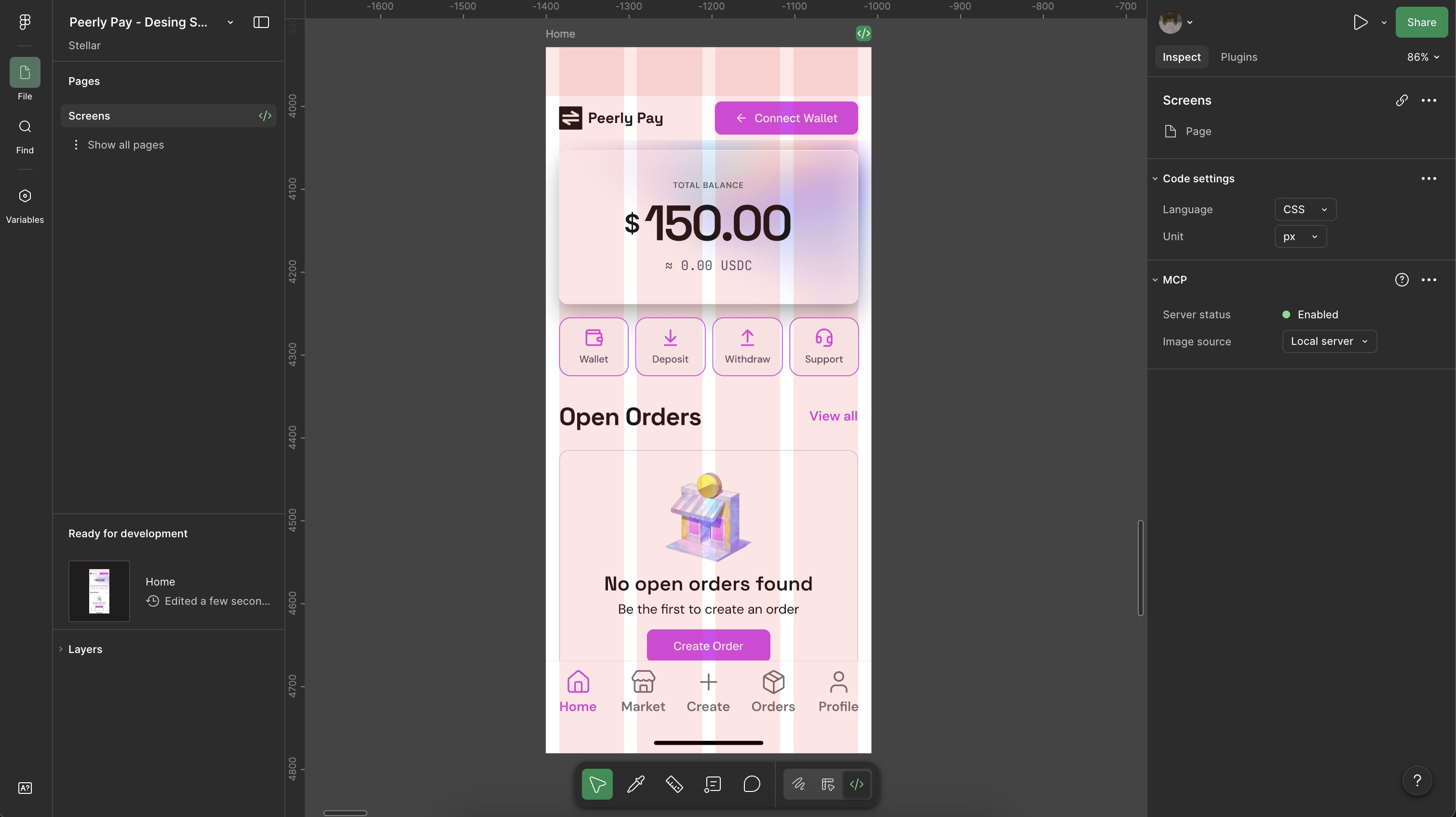
The product's foundation was built with an AI-assisted design-to-code workflow: starting from a PRD, one core screen designed in Figma, then Figma's MCP server generating implementation-ready specs that fed directly into Claude Code to build the actual components. That workflow is what let a small team move from a design decision to working, styled UI quickly enough to matter inside a hackathon-length sprint.
In the current phase, my focus has been on the frontend and the visual layer: refining flows, tightening the design system, and polishing the screens that carry the product's day-to-day experience, marketplace, trade flow, order management. Eli has taken the integrations layer further, wiring the wallet, oracle, and yield features that power what's underneath. That split, design and frontend on one side, deeper integration work on the other, is part of how a three-person team keeps moving without stepping on each other.
Outcome
PontePay started as a sprint build for PULSO Argentina and is still active today, with the team continuing to refine the product. The initial submission didn't advance to finalists, but the sprint proved out a working non-custodial trading flow with real on-chain infrastructure underneath it, and gave the team a real foundation to keep building on.